
Transport management
TMS is a system for managing transport and delivery: route planning, tariff calculation, documents, telemetry and settlements with drivers. It answers a simple but expensive question: what a kilometre of your delivery actually costs, and where exactly the money goes.
What it is
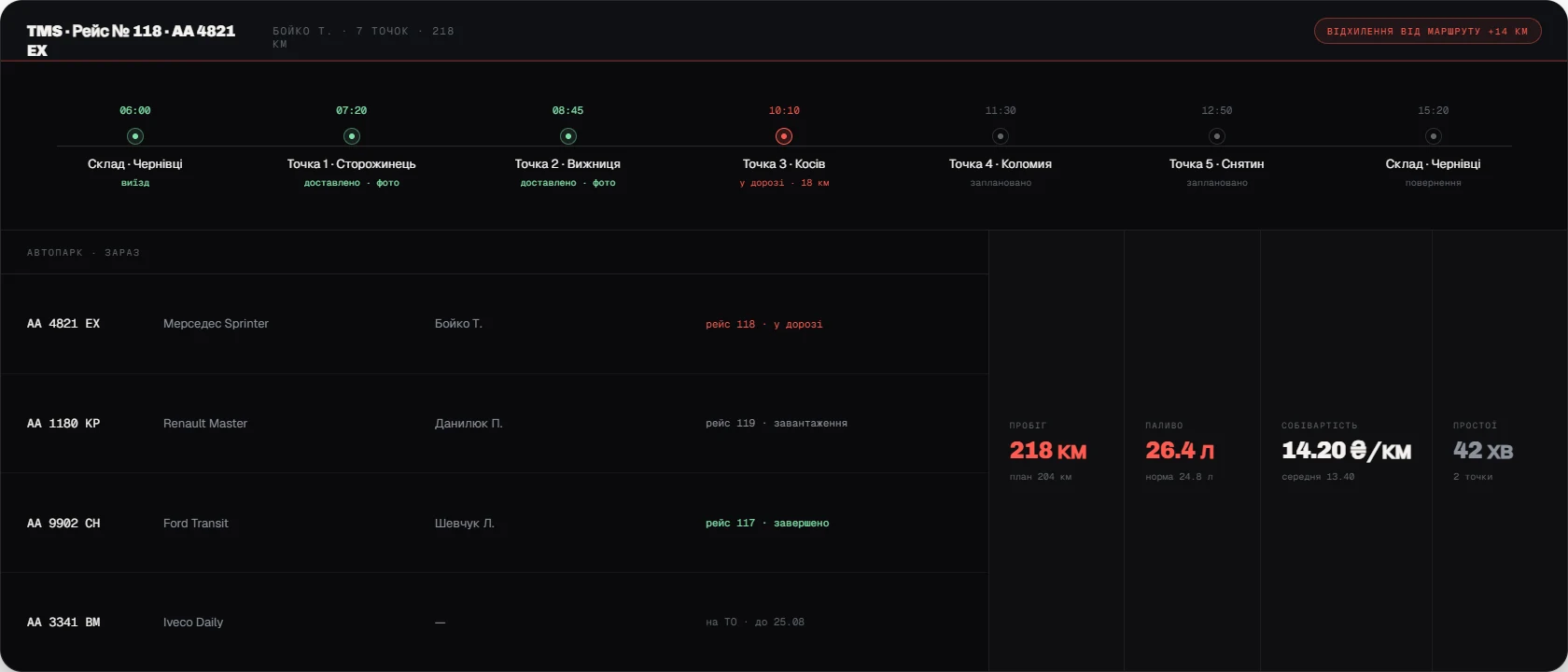
A Transport Management System treats a trip as its own accounting object: route, vehicle, driver, cargo, planned and actual times, fuel costs, toll roads and servicing. The system pulls data from GPS telemetry and fuel cards, so actual mileage and consumption are compared with the norm automatically. A deviation is visible straight away rather than at the end of the month while adding up receipts.
The second loop is the driver’s work in the field. Instead of phone calls and paper waybills the driver gets an app with the route, the list of stops and photo confirmation of delivery. The client sees the status, the dispatcher sees the real location, and the company has proof of handover without a round of phone calls. The driver’s pay is calculated from actual trips rather than from verbal arrangements.
Why you need it
TMS is needed when transport has become a significant cost line but is still managed by hand.
- Delivery cost is unknown
The company knows its total transport spend but not the price of a specific trip or client.
- Fuel spending is opaque
There is a gap between the norm and the fact, but pinning it to a specific vehicle is impossible.
- Routes are built by eye
The dispatcher picks the leg and the order of stops out of habit, with no calculation.
- No proof of delivery
The client says the cargo never arrived and there is nothing to settle the argument with.
What the system owns
TMS owns the planning, execution and cost of transportation.
- Trip planning
Routes, order of stops, vehicle loading, delivery windows.
- Tariffs and settlements
Tariff grids for clients, pay calculation for drivers and contractors.
- GPS telemetry
Actual mileage, speed, idle time, deviations from the route.
- Costs
Fuel, tolls, servicing, repairs, tyres — with a cost-per-kilometre calculation.
- Trip documents
Waybills, consignment notes, acts, photo proof of handover and of discrepancies.
- Driver app
Route, stop statuses, recipient’s signature and photo, contact with the dispatcher.
What implementation delivers
TMS turns transport into a manageable cost line: you see the cost of every trip, real deviations in fuel and mileage, and delivery is confirmed by a photo rather than by someone’s word. We connect TMS to the warehouse and the books so a trip is built from real orders and the costs land in finance straight away.