
Manufacturing execution
MES is a system for managing production in real time. It sits between the plan and the shop floor: it turns orders into tasks for work centres, records actual output and scrap, counts downtime and shows the true cost of a batch rather than the calculated one.
What it is
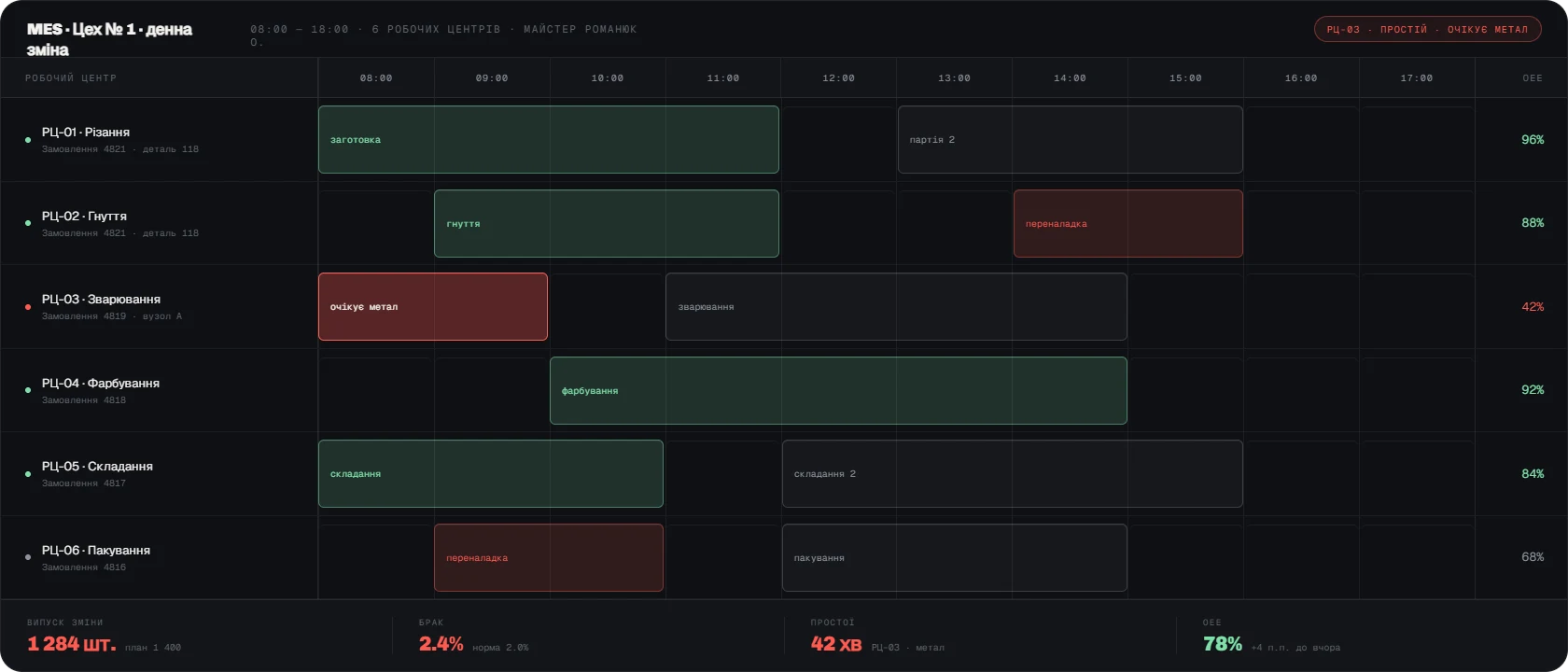
A Manufacturing Execution System runs production at the level of operations. An order is broken down into stages according to the route card, and each stage gets a work centre, a standard time and a list of materials. The operator marks the start and finish of an operation, the quantity produced and the scrap, so the system knows the state of every batch at the current moment — rather than at the end of the shift from what the foreman says.
This gives you the actual cost: how much material was really used, how long the operations took, what percentage was scrapped and at which link. Comparing fact against the standard shows exactly where productivity is lost — on changeovers, on waiting for material or on a specific machine. Losses like these are invisible in the financial books; they only show up at the level of operations.

Why you need it
MES is needed when a production plan exists but the actual progress of production is only known approximately.
- The state of an order is unknown
The question “where is that batch right now?” is answered after a walk around the shop.
- Cost price is theoretical
Real spend on material and time differs from the standard, but by how much is anyone’s guess.
- Scrap is not analysed
The scrap rate is known in general, without being tied to an operation, a shift or a machine.
- Downtime is not counted
Equipment sits idle, the causes are never recorded, so they can never be removed.
What the system owns
MES owns the execution of the production plan and the accuracy of production data.
- Tasks for work centres
Distribution of operations, the queue, priorities, changeovers.
- Route cards and standards
The set of operations, time and material norms, versions of route cards.
- Recording output and scrap
Operator check-ins, quantities, scrap reasons, returns for rework.
- Downtime and causes
Stoppages logged and classified: equipment, material, staff, changeover.
- Actual cost price
Real spend per batch: materials, time, scrap, energy.
- Shift reports
Output per shift and per crew, plan fulfilment, comparison against the standard.
What implementation delivers
MES makes the shop floor transparent: the state of every order is known the moment you ask, cost price rests on fact, and lost productivity has a specific address. We roll MES out together with ERP and EAM so materials are written off automatically and equipment downtime lands in maintenance records straight away.