
Business process management
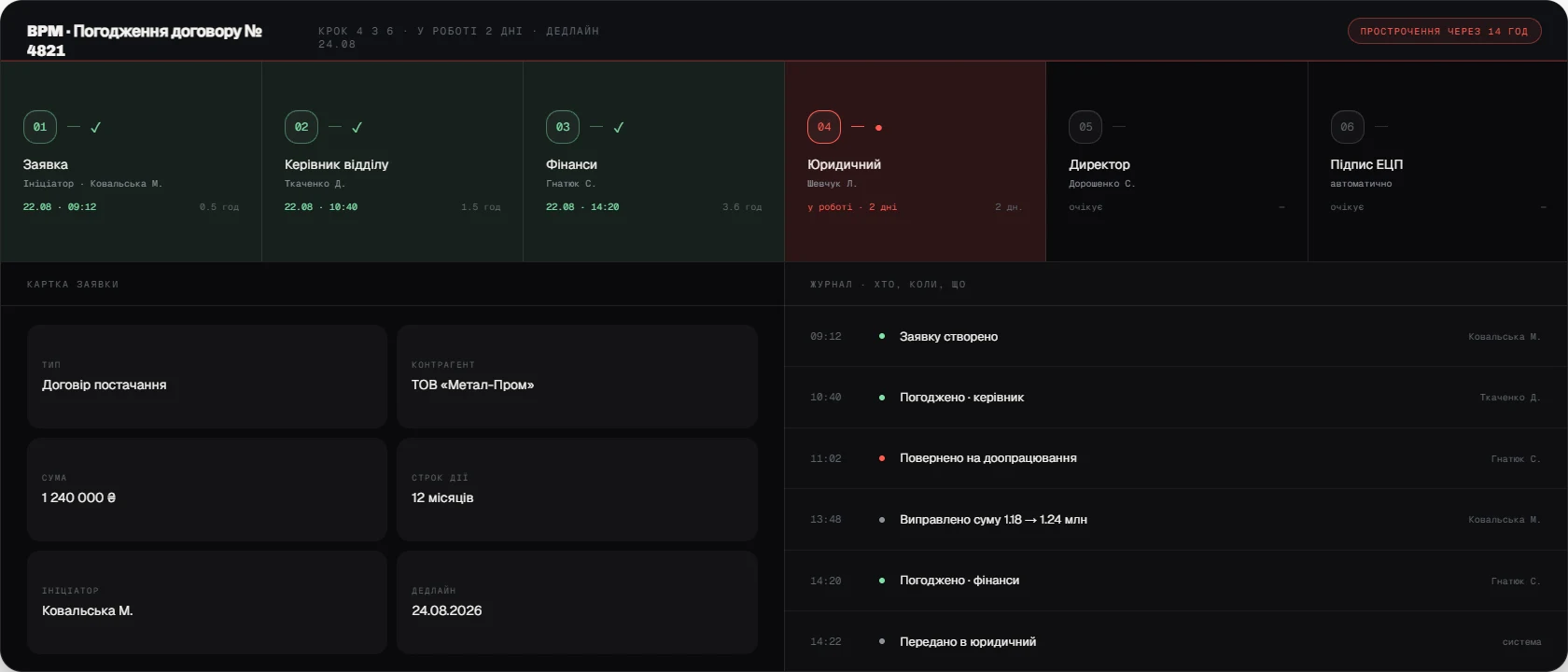
BPM is a system that moves approvals out of messengers, mail and paper into managed routes. A request travels through defined stages, every step has an owner and a deadline, and at any moment the system shows exactly who the process is stuck on. Instead of asking “who signs this off?” the answer lives in the system itself.
What it is
Business Process Management describes repeatable processes as a sequence of steps with conditions for moving on. Approving a contract, a spending request, hiring an employee, signing off a discount — each has its own route, form and rules. The system passes the task to the next participant, reminds about deadlines and does not let a mandatory stage be skipped. Signing happens with an electronic signature, so a paper copy becomes optional.
The second function of BPM is measurement. Every step records when it was entered and left, so after a month of work you see not subjective complaints but statistics: approving a contract takes eight days on average, six of which are spent waiting for one department. That turns a conversation about optimization from an exchange of opinions into work with numbers.

Why you need it
BPM is needed when approvals have become a job of their own, and their outcome depends on how persistent the person asking is.
- The process lives in chat
Approvals are scattered across chats and mail. Reconstructing how a decision was made a month later is impossible.
- There are no deadlines
A request can sit for weeks because it has neither a due date nor an owner.
- Paper circulation
Documents are physically carried between offices and copies get lost.
- Responsibility is blurred
When a decision turns out to be wrong, working out who actually made it is impossible.
What the system owns
BPM owns the controllability of repeatable processes and the transparency of decision-making.
- Route builder
Stages, branching conditions, parallel approvals, roles instead of specific names.
- Request forms
Structured forms with required fields and attachments — a request cannot start incomplete.
- Deadlines and reminders
A deadline on every step and automatic escalation to a manager when it is missed.
- Electronic signature
Legally valid signing of documents with no paper involved.
- Process analytics
Time per stage, bottlenecks, number of returns for rework.
- Audit and history
A full log: who changed what, when, and on what grounds a decision was made.
What implementation delivers
BPM cuts approval times several times over and makes the process visible to everyone involved. The manager sees where each request stands, the person doing the work sees their own task list with deadlines, and the company gets the statistics real optimization can be built on. We roll BPM out in stages: first the one or two most painful processes, then the rest.