
Enterprise asset management
EAM is a system for tracking and maintaining equipment and fixed assets. It keeps a record for every unit, a repair history, a service plan and the cost of ownership — and, most importantly, it reminds you about maintenance before a breakdown rather than after one.
What it is
Enterprise Asset Management describes every asset as an object with its own history: commissioning date, running hours, work carried out, parts replaced, costs. On that basis the system builds a planned maintenance schedule — by calendar, by running hours or by sensor readings. A repair request is created in the system, gets an assignee and a deadline, and the spare parts used are written off from stock tied to that specific piece of equipment.
The accumulated history gives you something invisible in the financial books: the real cost of ownership. After a year you can see which unit is eating the repair budget, what downtime it causes and at what point replacing it becomes cheaper than keeping it. A decision about capital spending stops being an argument and becomes a calculation.
Why you need it
EAM is needed when equipment has a real effect on production but is serviced only once it breaks.
- Repair instead of maintenance
Equipment is fixed after a failure, and that is always more expensive and slower than planned servicing.
- Downtime is not counted
Nobody works out what each hour of a stoppage cost or what caused it.
- Spare parts go missing
Write-offs are not tied to a unit of equipment, so its real running costs are unknown.
- There is no history
On sale or valuation it is impossible to show what was done to the asset over the years.
What the system owns
EAM owns the working condition of assets and the cost of keeping them running.
- Equipment register
A record for every unit: specifications, location, person responsible, documents.
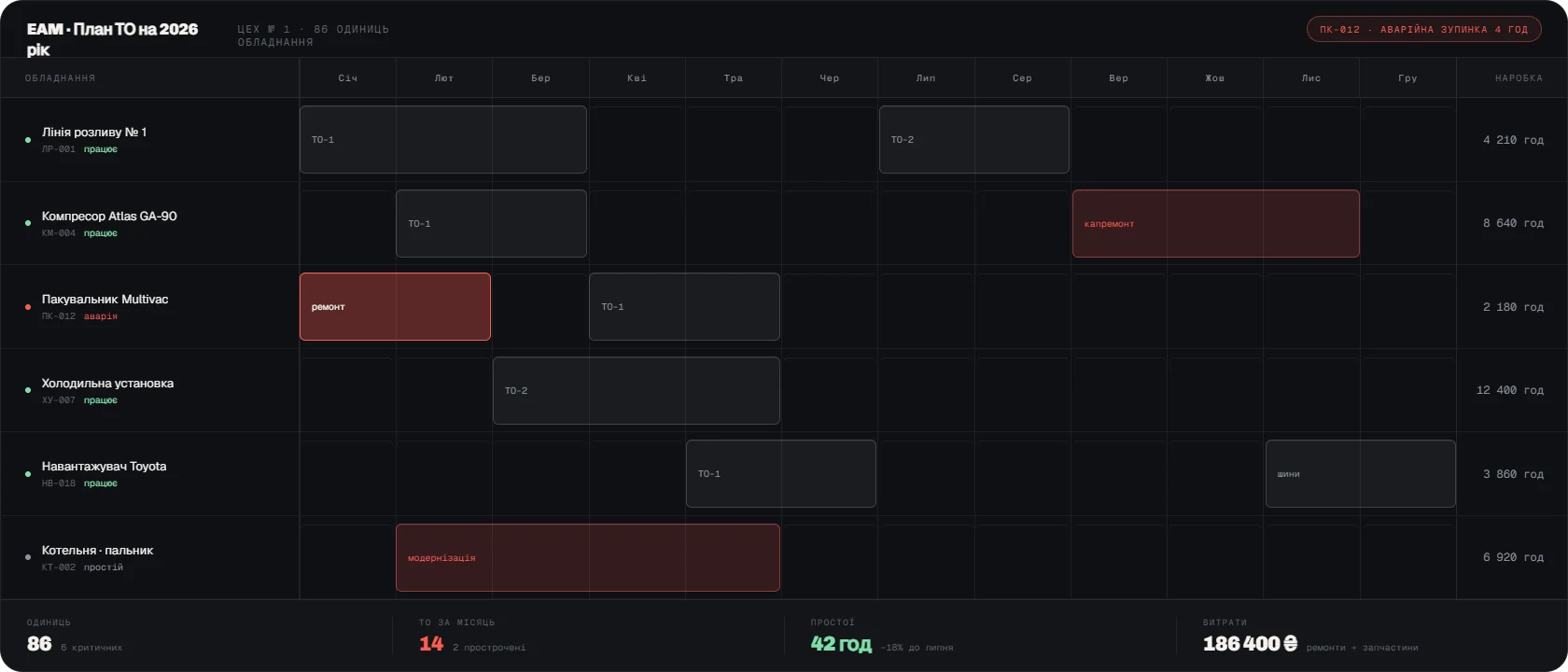
- Planned maintenance
Schedules by calendar, running hours or readings, with tasks created automatically.
- Repair requests
Logging the fault, the assignee, the deadline, the status, the history of work.
- Spares and stock
Write-offs tied to a unit of equipment, minimum stock levels for critical parts.
- Downtime and running hours
Recording stoppages and their causes, running time in hours or cycles.
- Cost of ownership
Total spend per asset over a period, compared against the alternative of replacement.
What implementation delivers
EAM reduces the number of emergency stoppages and makes the real cost of keeping equipment running visible. Instead of reacting to breakdowns there is a schedule, and instead of guesses about “that problem machine” there are figures for spend and downtime. We connect EAM to MES and to the warehouse so downtime shows up in production reports straight away.