Learning management
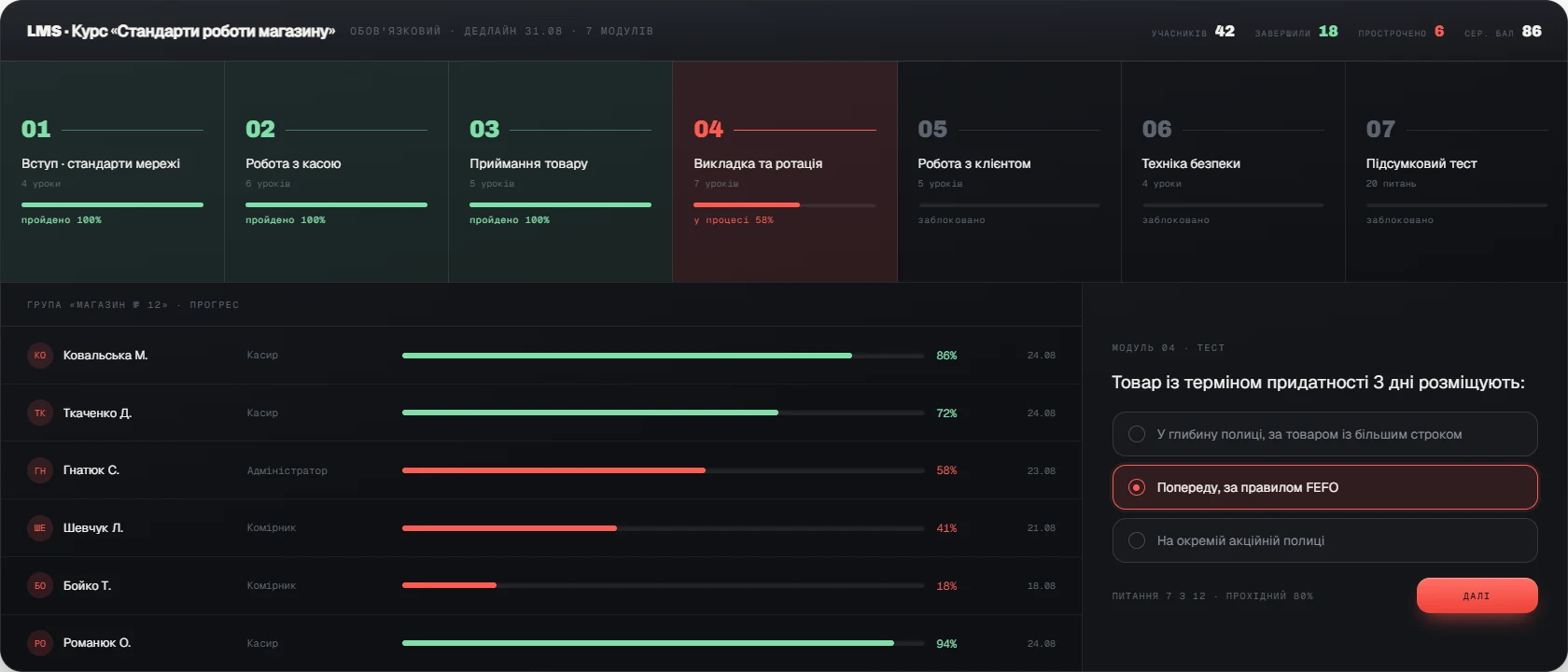
LMS is a system for training staff or clients: courses with materials and video, tests marked automatically, certificates and clear progress for every participant. It moves training out of the category of one-off events and into a process whose result can be measured.
What it is
A Learning Management System stores training content as structured courses: modules, lessons, reading material, video, practical assignments. A participant works through the programme at their own pace, the system records every step and does not let them go further until a mandatory test is passed. Marking is automatic, so training at scale creates no extra load on the trainer.
For a company the main value of an LMS is evidence. At any moment a manager can see who has completed the mandatory briefing, who is stuck on a module and whose certification is about to expire. That is critical wherever training is a requirement: safety rules, working with equipment, service standards. Instead of signatures in a paper log there are records in a system, with dates and results.

Why you need it
An LMS is needed when training is mandatory but its result is never recorded anywhere.
- Training does not scale
Every new employee is trained by hand, and the quality depends on who happened to do it.
- There is no proof
The company cannot show that an employee went through a briefing, or who delivered it.
- Knowledge disappears
Experience stays in people’s heads instead of in material the next employee can use.
- Certification dates are not tracked
You learn that a clearance has expired at the moment of an inspection.
What the system owns
An LMS owns the creation, delivery and control of training.
- Courses and modules
Programme structure, materials, video, attachments, the order things are taken in.
- Tests and auto-marking
Different question types, a question bank, random selection, a pass mark.
- Certificates
Issued automatically, with a validity period and reminders to retake.
- Progress and reports
Status of every participant, time taken, weak spots by topic.
- Mandatory training
Programmes assigned by role, deadline tracking, escalation to a manager.
- Payments and subscriptions
For external training: selling courses, access, promo codes.
What implementation delivers
An LMS makes training the same for everyone and documented. A new employee arrives at their post with a base of knowledge rather than a colleague’s retelling, and the company holds proof that briefings were completed. We build an LMS together with HRM so programmes are assigned automatically by position.