Product lifecycle management
PLM is a system that holds all the information about a product from the idea to the end of production: specifications, bill of materials, drawings, versions, changes and approvals. Its main value is that the designer, the process engineer and purchasing all work on one current version rather than on files scattered through email.
What it is
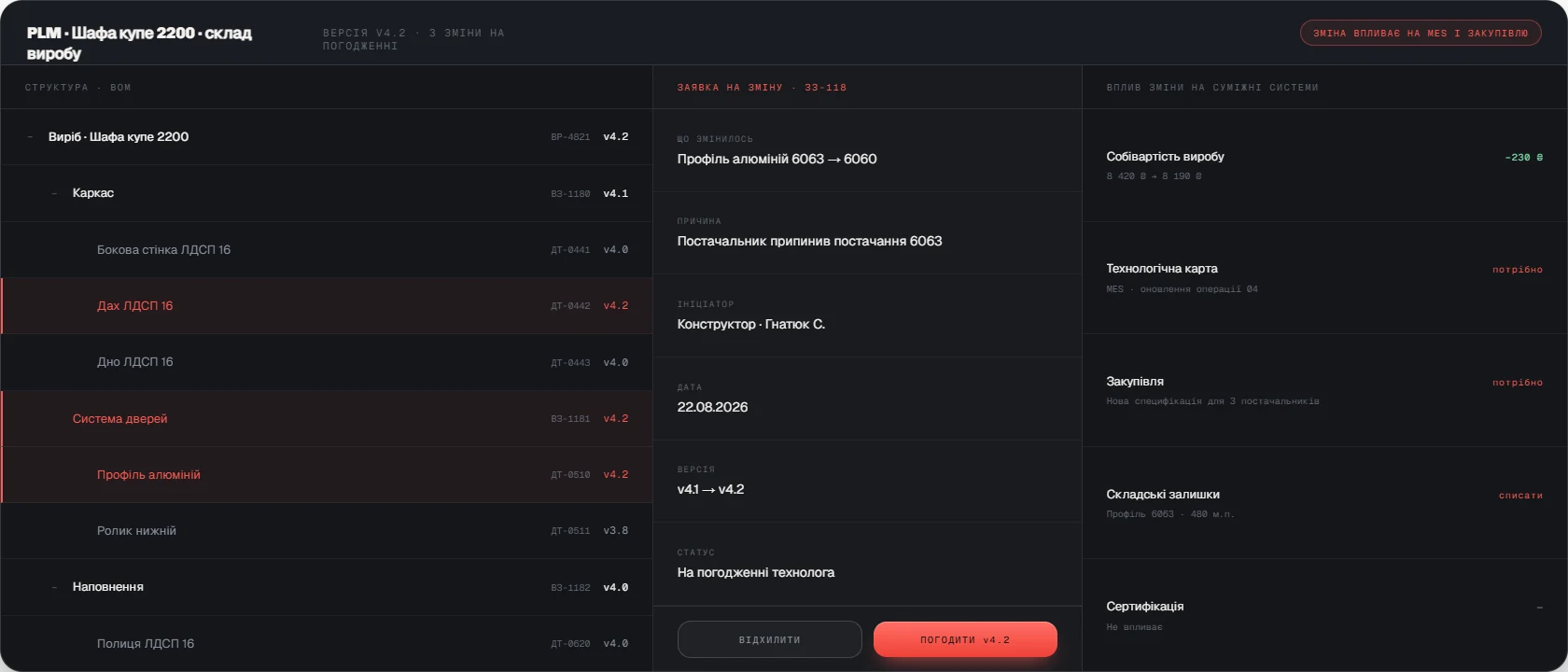
Product Lifecycle Management describes a product as a structure: bill of materials, assemblies, parts, materials, standards. Every change goes through a procedure: request, justification, approval, publication of a new version. The system keeps every version with its history, so it is always known which revision a specific batch was made to — which is critical for complaints and for certification.
The second function is the link to the rest of the systems. From a PLM specification comes the production route card for MES, the material requirement for purchasing and the cost calculation for the ERP. When a designer changes a part, that change reaches the shop floor and purchasing as a managed event rather than as an email saying “note that it is different now”.
Why you need it
PLM is needed when a product is complex, changes often, and several departments work on it.
- Versions drift apart
The shop floor works to an old drawing because the new one stayed in the designer’s mailbox.
- Changes are not controlled
An edit is made, but nobody works out what it means for purchasing and for cost price.
- There is no history
When a complaint arrives it is impossible to establish which revision the batch was made to.
- Documentation is scattered
Drawings, specifications and certificates sit in different folders and with different people.
What the system owns
PLM owns a single, current source of information about the product at every stage of its life.
- Bill of materials
A multi-level structure: assemblies, parts, materials, consumption standards.
- Versions and history
Every revision preserved with its chronology and the author of each change.
- Change approval
An approval route for each edit, with an assessment of its effect on cost and purchasing.
- Documentation
Drawings, specifications, certificates and instructions tied to a version.
- Link to MES and ERP
Route cards passed to production and material requirements passed to purchasing automatically.
- Access rights
Separated rights for design, process engineering, purchasing and production.
What implementation delivers
PLM removes the gap between what was designed and what is being made. Changes reach everyone involved as a managed event, version history makes complaints resolvable, and cost price is recalculated together with a design edit. We roll PLM out in stages, starting with the product group that changes most.