
Supply chain management
SCM is a system that makes the whole path of goods visible: from a demand forecast and an order to the supplier through to receiving at the warehouse and handing over to sales. It answers the two questions that decide how fast your money turns over: what to order and when so you do not run out, and how not to freeze capital in surplus.
What it is
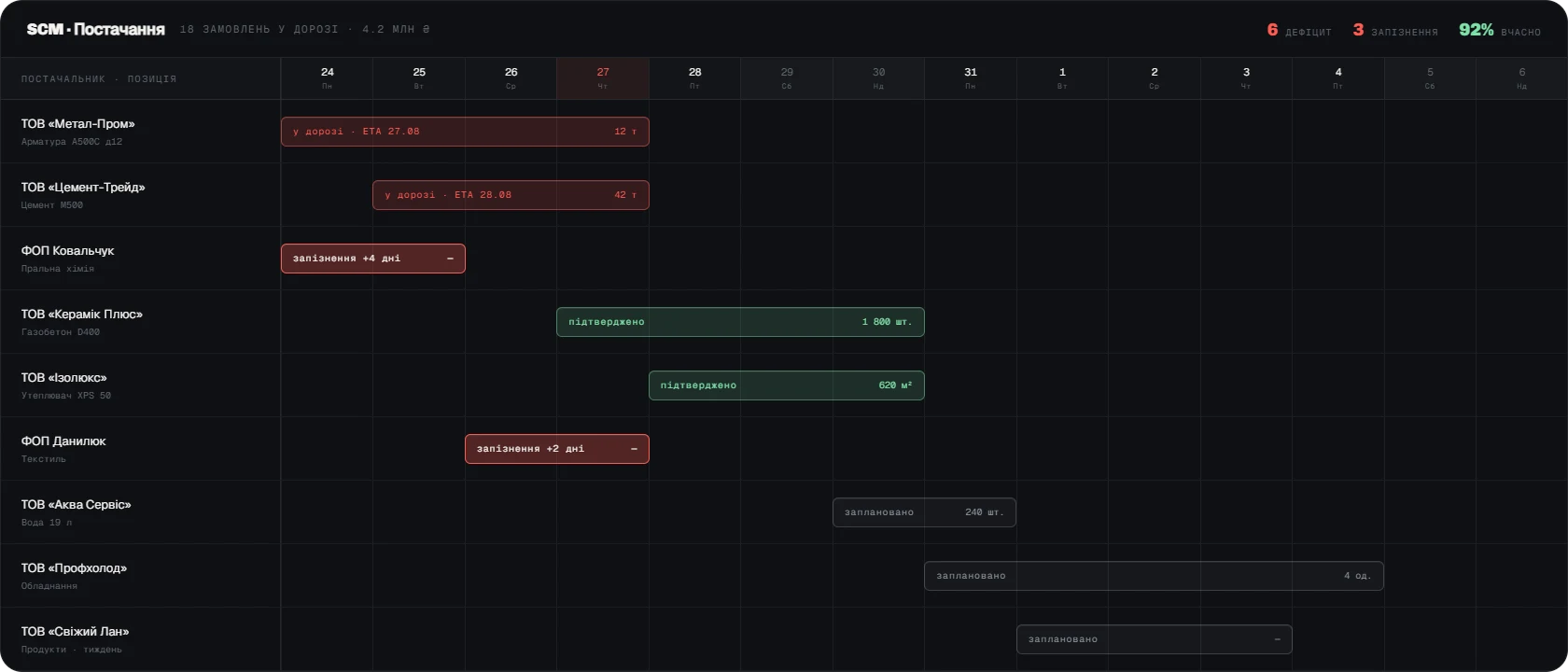
Supply Chain Management covers planning, purchasing, supply and distribution of goods between warehouses and points of sale. The system gathers sales history, seasonality, current balances, goods in transit and real lead times for every counterparty, and on that basis works out what needs to be bought. An order stops being a decision made by eye — it rests on statistics and on the constraints built into the system.
A separate and important loop is checking delivery. SCM records the promised lead time and compares it with the actual one, building an objective score for every supplier. After a few months of work you know exactly who misses the schedule, whose quantity deviations are largest and with whom the terms are worth revisiting. That is the kind of data you can never pull out of an email thread.

Why you need it
SCM is needed when the company’s money sits in goods and purchasing decisions are made without any calculation.
- Best-sellers run out
The goods that sell best regularly go out of stock. Sales are lost for no reason at all.
- Capital is frozen
The warehouse is full of items that have not moved for months, while there is no money left to buy what is actually needed.
- Lead times slip
A supplier promises two weeks and delivers in five, and the whole plan falls apart.
- Nothing is visible
Nobody can quickly say what is in transit right now, when it arrives and whether it covers the need.
What the system owns
SCM owns the movement of goods and the planning of purchases across the whole chain.
- Demand forecast
Requirements calculated from sales history, seasonality and current momentum.
- Purchase orders
Orders built around minimum batch sizes, lead times and balances, with approval and delivery tracking.
- Goods in transit
Status of every shipment, expected dates, partial deliveries, discrepancies on receipt.
- Multi-warehouse and transfers
Distribution between warehouses and points, internal transfers, balancing of stock.
- Stock analytics
Turnover, shortages, surplus, dead stock, ABC analysis of the range.
- Supplier scoring
Actual lead times, accuracy of quantities, price, share of failures — an objective rating instead of impressions.
What implementation delivers
SCM shrinks two opposite problems at once: shortages of fast-moving goods and surpluses of dead stock. The company starts ordering by calculation, sees everything in transit and negotiates with suppliers from facts. We build SCM together with ERP and WMS so the forecast rests on real balances rather than a separate spreadsheet.