
Governance, risk and compliance
GRC is a system that brings policies, risks and control procedures into one managed loop. It answers the question that usually arrives too late: which risks is the company carrying right now, which controls are meant to cover them, and are those controls actually being performed?
What it is
Governance, Risk and Compliance has three interlinked parts. Governance is formalized policies and regulations with versions, owners and confirmation that employees have read them. Risk is a register of risks scored by likelihood and impact, each with an owner and a response plan. Compliance is the control procedures, the checks that they are performed, and the log of findings with a remediation plan. Together they give a picture in which a risk, its control and the actual state of that control are linked.
The practical value of GRC is the move from occasional checks to continuous monitoring. Instead of a scramble before an audit, the system accumulates evidence that controls were performed as part of normal work: who checked what and when, what deviations they found and what was done about them. Management receives the state of compliance as a regular report rather than as the outcome of a separate project.
Why you need it
GRC is needed where regulatory requirements are significant and compliance with them is proven by hand.
- Risks are not systematized
Each department sees its own risks; there is no consolidated picture for management.
- Policies exist on paper only
Regulations are written, but neither reading them nor following them is confirmed anywhere.
- An audit becomes an emergency
Before an inspection the company spends weeks collecting evidence of what it did all year.
- Findings are never closed
Deviations are recorded, but nobody tracks whether the remediation plan was carried out.
What the system owns
GRC owns the manageability of risk and the evidence that requirements are met.
- Risk register
Likelihood and impact scoring, an owner, an acceptable level, a response plan.
- Policies and regulations
Versions, owners, and confirmation that employees have read them.
- Control procedures
Description of the control, its frequency, the person responsible, how it is evidenced.
- Internal audits
Audit plan, results, findings with a classification.
- Remediation plans
Actions, deadlines, owners, and tracking that findings are actually closed.
- Reporting for management
Consolidated state of risk and compliance, trends, critical open items.
What implementation delivers
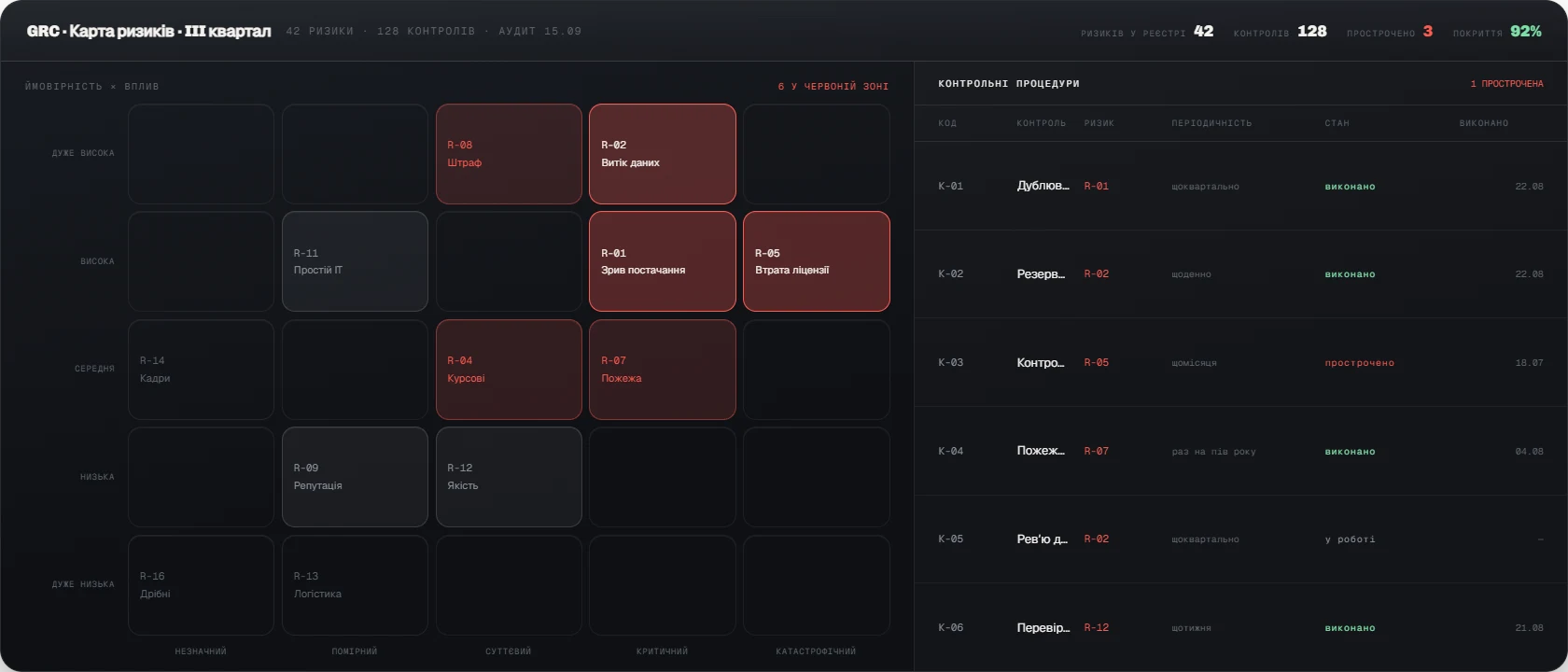
GRC moves compliance out of audit-preparation mode and into a continuous process with accumulated evidence. Management sees a consolidated risk map and the real state of controls, and every finding has a deadline and an owner. We roll GRC out in stages: first the risk register and the critical controls, then the full cycle of audits and reporting.