
Online store
An online store is a site that takes a visitor from searching for a product to a paid order without a manager in between. Catalog, filters, product page, cart, checkout, payment and handover of the order into your accounting all work as one chain: if any link breaks, the sale does not happen. That is why a store is designed as a process, not as a set of pages.
What it is
Technically an online store has four layers. The catalog holds products, categories, attributes, prices and stock. The storefront shows them to the user with filtering, sorting and search. The order loop tracks the cart, delivery, payment and statuses. The admin panel lets the owner manage the range and see what is happening with every order.
The key difference between a store and a catalog site is the transaction. A catalog can live with slightly stale data; a store cannot. If the site says an item is available and the warehouse says it is not, the customer gets a cancellation. That is why a real store is almost always integrated with an accounting system, delivery services and a payment provider rather than standing on its own.
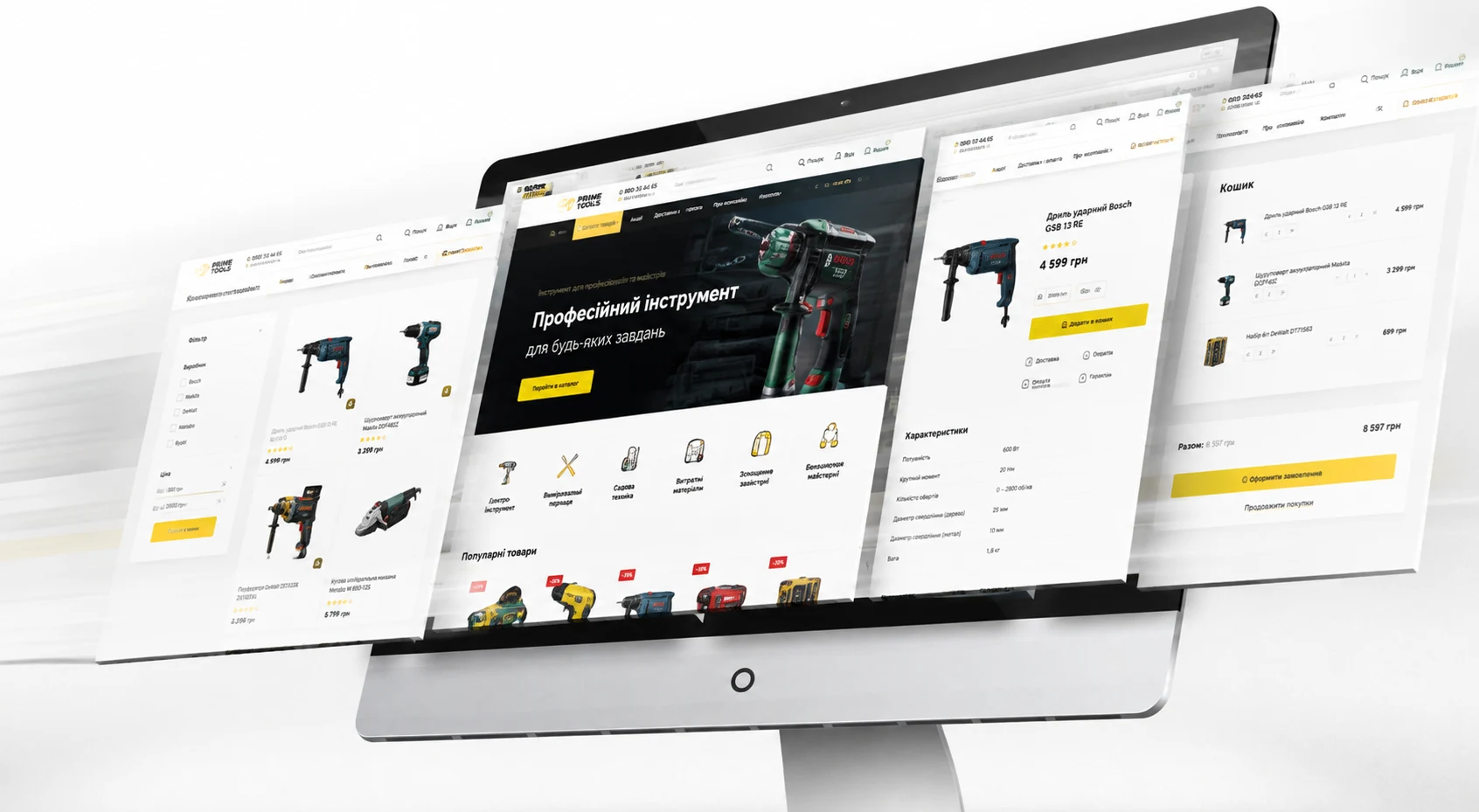
Who needs it and when
A store is needed when selling stops being a conversation and becomes a flow. The signs of that moment look the same across very different niches.
- The manager became the bottleneck
Orders arrive by phone and in messengers, and the number of enquiries is already more than one person can process without mistakes.
- The range no longer fits a price list
There are hundreds or thousands of items with sizes, colours and specifications — a buyer will never find them in a file, but will find them in a filtered catalog in half a minute.
- Sales are invisible in numbers
There is no data on which products are viewed, which are abandoned in the cart and at which step the customer leaves.
- You are paying for someone else’s traffic
A marketplace brings the buyer but takes a commission and keeps the customer’s contact — so the repeat sale has to be bought all over again.
What the site owns
A store owns the entire path of the buyer and the data the sale rests on.
- Catalog and attributes
Categories, brands, sizes, colours, compatibility. The structure of attributes decides how precise the filters can be.
- Search and filtering
Search with suggestions, filters by parameter, sorting and comparison. On a large catalog this is the main selling tool.
- Cart and checkout
The fewest possible steps to payment, a saved cart, promo codes, delivery calculation, guest checkout.
- Payment and delivery
Integrations with payment systems and carriers: creating the waybill, parcel status, returns.
- Stock synchronization
Exchange with the accounting system: prices, availability, order statuses. Without it a store sells what it does not have.
- Customer account
Order history, one-click repeat purchase, saved addresses, wish lists.
What launching delivers
A finished store turns an enquiry into an order with no manual work: the customer finds the product, sees real availability, pays and receives a tracking number, and the order lands in the books immediately. We build a store starting from the catalog structure — it decides how convenient the filters are, what the future SEO looks like and how easy it will be to grow the range.